Under the Acacia with Aisha

In this world in which the tentacles of the internet are wrapped all around us and algorithms rule, we tend to find friendship in ever-tightening circles. I know somebody who claims with pride that all of her Facebook friends are of the same political persuasion.
Hmmm… I wonder about that. About the origins of connection, the necessity of alignment, and just how much we can really manage something as mysterious as friendship.
During Pre-Service Training in Mali, West Africa, I was eager to learn how to be an outstanding Peace Corps Volunteer. I wanted to do things the right way when I reached my assigned village after three months of training.
I learned how to construct the foyer amélioré (improved woodstove) from clay. I was schooled in Community Development, also known as “how to make an impact in a foreign culture without imposing your values on the locals.” I made a feeble start at learning Bambara, a West African dialect, and French.
Shortly before we were to leave the training site and head out to our villages, seasoned volunteers converged on us to share their wisdom.
I sat on a grass mat under a tin-roofed veranda with forty-one other trainees. We swatted flies and sipped from plastic canteens filled with chlorine-spiked water. One guy, a second year PCV in tie-dye pants and tee shirt, addressed us. I was all ears.
“Just remember this—you should make friends with the paysanne (peasants), so you can learn about your village. Don’t hang out with the fonctionnaires (government employees). They aren’t from the village—they’re from other parts of Mali and from a different social class. Your goal is to learn about your village and you can’t learn what you need to know from them.”
A female PCV, her light-brown hair fixed in Malian-style corn rows, added, “And you women, especially in the Woodstove program, should definitely hang out with the paysanne women, to be able to recruit them to accept the foyer amélioré.”
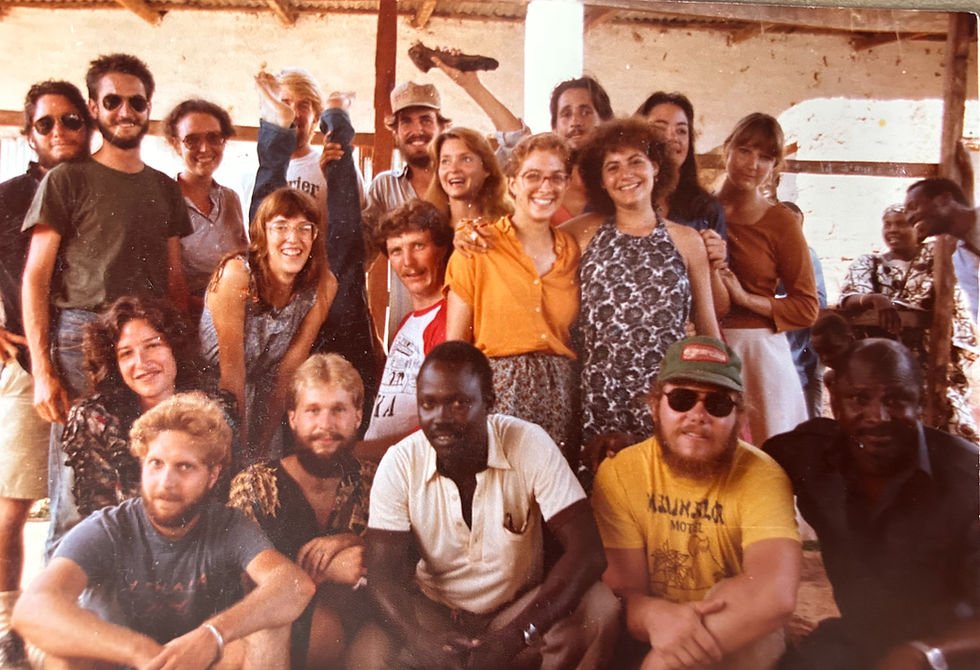
I arrived at my assigned village of MPessoba, population 1,500, a few weeks later. My body lurched between diarrhea and constipation, and my emotions lurched between homesickness and fascination at this village with its mud-brick houses surrounded by fields of millet and cotton. My language lurched from English in my head to Bambara on my tongue and French on paper. Even with all the lurching I was determined to start integration into village life right away.
I set out to find my target friends.
I focused in on Mamani, the second wife of Mamadou Daffe, my Bambara language teacher. Of Daffe’s three wives she seemed the most approachable, and I figured she was close to my age (27 at the time). I would make Mamani my friend and learn about village life from her.
Each morning for a week I visited the Daffe compound, announcing I was there to visit Mamani. Each day one of the children would fetch me a stool to sit on and a cup of water to drink. Mamani, with an infant strapped to her back, would stop to exchange greetings with me. I k’a kene wa?—How is your health? I somogow k’a kene wa?—How is your family’s health? Then she would be off, to gather firewood, to pound millet, to go to the market, to work in the fields. I would sit on my stool, surrounded by chickens and children, until it was obvious that I might as well go home.
Friendship efforts with Mamani aborted, I discussed the issue as best I could with Amadou Coulibaly, my landlord. He must have said something to somebody because the next day a group of npogotigi arrived at my concrete-block house on the edge of the village.
Npogotigi is the Bambara word for an unmarried woman. It translates as “hymen owner.” Although I hadn’t owned a hymen for a while, the fact that I was unmarried put me in the same social stratum as these 13 to 15 year old girls.
I invited the girls into my house where they rifled through my clothes and giggled at my attempts to converse in Bambara. When they left, obviously bored, I had to pry a bra from the hands of their leader.
The friend thing was obviously more complicated than I'd anticipated, but thankfully there was still the stove-building work to do. Plus I had my protocol list.
Protocol is big in Mali, I’d learned in training. You must visit the local dignitaries and pay your respects, definitely when you first arrive in the village and preferably every time you come back from a trip.
Top of my protocol list was the biggest of the local bigwigs—Monsieur Cissé, Commandant de Cercle. Kind of like the head of the county government. When I arrived at the Cissé compound, I parked my Peace Corps-issued Peuguot moped, then walked through the adobe-walled entrance. I clapped my hands, and announced myself with the standard greeting. Assalaamu ‘Aleykum—"Peace be on you."
A young woman who was shelling peanuts returned the greeting. Wa alaykumu s-salam—"Peace be on you also." When I asked for Cissé, she said he was out of town. She introduced herself as Djenaboo and led me to a corner of the compound. There, shaded by an acacia tree, was a corpulent woman stretched out on her side on a grass mat. A fleshy arm supported her head. She sat up long enough to shake my hand and exchange greetings. Her name was Aisha.
I gave her the speech in Bambara that I had practiced during training for use in introductions. I used my Malian name—Tene Keita—since my real name was unpronounceable to the Malians. Serving with the Peace Corps. From Wyoming, USA. In MPessoba to teach people how to build improved woodstoves. Looking forward to working with the people of Mali.
Aisha listened intently, then turned to Djenaboo, who translated what I’d said into an unfamiliar-to-me language. Djenaboo explained to me, in Bambara, that they were members of the Soninké tribe and had arrived in MPessoba only last month.
Aisha be Bamanakan kalan, dooni—"Aisha is learning to speak Bambara, slowly," Djenaboo said.
Great. No common language. This was going to be fun.
Aisha spoke in Soninké to a young boy and a chair appeared. In Bambara she said, I sigi—“You sit.”
Aisha smiled, displaying black-tattooed gums. I smiled back. She spoke, gesturing toward my moped, but I couldn’t catch what she was saying. N m’a famu—“I don’t understand,” I said.
I y’a famu—“You DO understand,” Aisha said.
She handed the boy some coins. We sat in silence, watching two children play with cars made of tin cans. The boy returned with grilled goat’s meat, wrapped in a square of greasy brown paper. Aisha spread the paper out on the mat and pointed at the meat. Duminike—“Eat.”
Two days later I was bargaining for tomatoes at the market when Djenaboo tugged on my sleeve and told me I should come visit that afternoon. I asked if Cissé was back from his trip. No, he wasn’t. It was Aisha who was summoning me.
And so began my monosyllabic friendship with the biggest fonctionnaire family in the village. My PCV mentors would have slapped me upside the head if they’d found out.

I visited the Cissé compound a couple times a week. Aisha and I sat in the shade, sometimes for hours. We talked, but sparingly. I listened to the acacia leaves rattle in the hot breeze like strips of dried newspaper. We played with the children and Aisha delivered orders, usually from a prone position. I often stayed until the muezzin called the faithful to afternoon prayer.
I did finally meet the man of the house, Amadu Cissé, when he returned from an extended trip to Kaye. A tall man, he strode around the compound and harangued his family in Soninké and delivered speeches in Bambara or French to visitors. He expressed his pleasure at having an American visit his family so often.
Our Bambara improved over time and soon Aisha was giving me lots of advice. She waggled a finger at me and told me to quit holding hands with the village children because they would give me pinkeye. On how to avoid heat rash, she said to wear loose clothing and take a bucket bath twice a day. I shouldn’t eat too many mangoes. They would give me sores on my mouth. She insisted I was showing too much ankle for a woman of my age and ordered Djenaboo to give me a lesson in the proper way to tie a pagne—the large squares of cloth that served as skirts.
If Aisha didn’t know the word in Bambara she’d just throw in Soninké. When I said I didn’t understand she always laughed and insisted, I y’a famu, Tene!
On Malian Independence Day, September 22nd, I joined the villagers at the schoolyard for the festivities celebrating Mali’s liberation from French rule in 1960. I knew Aisha would be making one of her rare appearances outside the family compound. Cissé and Aisha sat in chairs in front of the crowd. Each was dressed in a glowing white brocade gran boubou—a flowing robe embellished with elaborate gold embroidery. Aisha had an elegantly tied white scarf on her head.
Cissé rose and spoke in Bambara about the glory of Mali. He reminded everyone of the significance of the colors in the Malian flag: green for hope; yellow for the plentiful gold that came from Mali’s earth; red for the blood sacrificed during the struggle against colonization. He finished by offering benedictions for peace and prosperity to all.
The villagers filed past, offering greetings to the impressive couple. I hung back in the crowd, suddenly shy. My friend was in her role as the grand wife of a high-ranking man. How should I greet her—like an old friend, or like a subservient villager?
I also worried that if I received a warm greeting from Aisha and Cissé I would be seen by the villagers as one of them—one of the fonctionnaires.
So I didn’t go to greet them at all. I stayed away from the Cissé compound for a week, wondering if my cowardice would be viewed as betrayal. When I finally dragged my way back to Aisha, nothing seemed to have changed. She was eager to gossip about the big celebration.

One day Cissé approached and said he wanted to show me his new purchase: two head of cattle. He led me to a shed outside of the compound where two boney-hipped cows chewed on millet stalks. Cissé slipped his arm around my waist and pressed me into the wall. I pushed him away and delivered a speech I had used often with Malian men who assumed because I hadn’t received the rite of clitoridectomy I was surely dying to have sex with them: It is against my religion to have relations with a married man.
I hustled back to Aisha's side, wondering if she knew what had just happened. I tried to cover my nervousness by telling her about a recent trip to Sikasso to celebrate Thanksgiving with my fellow PCVs. Aisha listened quietly. She offered me some shea butter lotion and we spread it on our arms and ankles. When Cissé walked past us and disappeared into the latrine, I detected the curve of a smile on Aisha’s lips.
One time I returned from a trip to find Aisha with an infant boy at her breast. I hadn’t even known she was pregnant. Not that surprising, given that it's taboo in Mali to discuss pregnancies—considered bad luck—and women dress in loose robes. Allah k’a dahirime nogoya, I said—“May God make it easy to provide him with food.” Amina, Aisha answered—“Amen.”
She had dark circles under her eyes. I sat with her a long time, even while she napped. When I got up to go home, Aisha stopped me. She sent Djenaboo on an errand and then asked me if it was true what she had been told—that in America there is a pill that would keep women from having babies. I said yes, there is such a thing. Aisha gazed at the mango-hued sunset for a time, then said, O ka nyi. “That’s good.”
We never spoke of it again.
When my two year tour of service was over, I extended for a third year and moved to Bamako, Mali's capital city. Every couple of months I returned to MPessoba, always stopping by the Cissé compound. Aisha would sit up and yell Tene nana—“Tene has come!” She'd pump me for news from the city and ask questions about my job at the Solar Energy Laboratory. When it was time for me to go, she would say, K’an bu fo—“Greet the people” and I would reply, U n’a men—“They will hear it.”

I was medivacced to Washington D.C. a month before my close-of-service date due to a punctured ear drum. My quick departure meant I could not get back to MPessoba. I sent a letter, written in French, by taxi to Aisha, apologizing for not saying a proper goodbye. I thanked her for her friendship and expressed the hope that we would meet again one day, Inshallah—“God willing.” I imagined Cissé reading the letter to Aisha under the acacia tree.
I never saw Aisha again. I don’t know if she is still alive.
Yet our odd connection remains with me, because in spite of the fact that our thoughts formed in different languages and we were from different continents, ethnicities, and religions, we were friends. Something melded during those hours under the acacia.
Maybe we were two puzzle pieces that fit—I needed a friend and Aisha wanted a glimpse of the world beyond her family compound. Maybe the fact that we were both female and outsiders in the village was enough to cause the click.
I believe that friendship may be more alchemy than algorithm. My friendship with Aisha taught me to always make the effort to look beyond. Beyond agenda and similarity. Beyond matching interests.
When I think of Aisha I see white teeth in a flashing smile. I smell shea butter and ripe mango. I hear the sucking of a baby at Aisha’s breast. And I hear her say, once again, I y’a famu, Tene—“You DO understand.”
Beautiful story! It's amazing how the increased ease in communication technology has brought has narrowed social circles. Here, a struggle to communicate across language and cultural divides widened your world.
Your writing transports me to that hot corner of Africa. I marvel at the inroads you made in that complicated social structure. I’m waiting for a chapter about the perforated ear drum!
Thank you for sharing a part of your past with your readers, Lynn. What an adventurous thing to do, joining the peace corp. And you kept the photos from all those years ago!
I always so love your stories of Mali, Lynn. And this story of friendship hits home at the moment. Thank you for this lovely piece.